
Certification
Certification is a formal recognition of professional competency. It enhances credibility; ensures adherence to standards; promotes continuous professional development; and ultimately provides assurance that child welfare professionals possess the knowledge, skills, and attitudes that ensure the safety, permanency, and well-being of children and families.
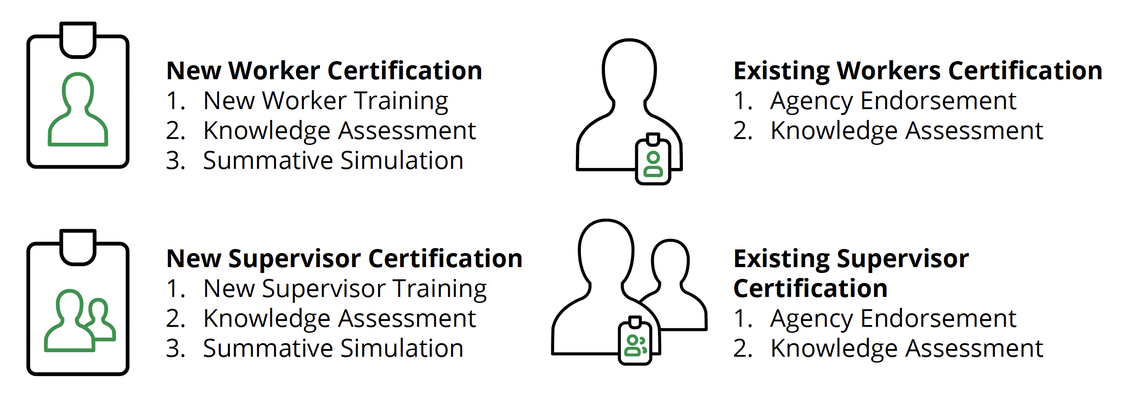
In January 2027, we will begin a phased rollout of the New Worker Pathway to certification. To earn certification, new workers must complete New Worker Training and both the Knowledge Assessment and Summative Simulation. Existing workers may earn certification through a temporary (available July 2027 – July 2029) Legacy Pathway which requires completing the Knowledge Assessment and securing agency endorsement. For the Legacy Pathway, and during the first phase of the New Worker Pathway, assessments are only used for professional development, as passing the assessments is not required. In January 2028, we will launch the second phase of the New Worker Pathway that requires new workers to achieve passing scores on both the Knowledge Assessment and Summative Simulation to earn certification. The Supervisor Certification Pathway is currently in development; updates to follow on the launch of this Pathway.
Certification Pathways
Recertification
Workers and supervisors will need to renew their certification every two years, starting from their initial certification date. Recertification requires 30 hours of continuing education (15 hours per year) through a combination of MNCWTA training and other professional development opportunities.
Worker Certification Phased Rollout Strategy
The program will move from a transition period to full implementation in distinct phases. This ensures the assessments are fair, the technology is seamless, and counties are familiar with the process before passing the assessments becomes a requirement.
| Phase | Timeline | Requirement & Impact |
|---|---|---|
|
Phase I
New Worker Rollout
|
January 2027 | New workers must complete the Knowledge Assessment and Summative Simulation. Passing scores are not required for certification during this phase. Workers receive formative feedback on strengths and growth areas. |
| Legacy Rollout | Summer 2027 | Existing workers must take the Knowledge Assessment for professional development rather than as a pass/fail barrier. The Summative Simulation is not required. |
|
Phase II
New Worker Rollout
|
January 2028 (anticipated) | Passing scores are required for New Workers. Passing scores will be established based on formal standard-setting studies using "live" data collected during Phase I. |
Our phased approach to rolling out Worker Certification transforms training into verified competency while offering several strategic advantages:
- Standards-Based: Aligning with national standards ensures fairness.
- Data-Driven Accuracy: By using "live" data from Minnesota workers to set passing scores, we ensure the test is fair and accurate.
- Supportive Development: Phase I provides workers with immediate, rich feedback to guide their professional growth early in their careers.
- Worker Credibility: Provides counties with a turnkey system for verified field readiness, building credibility for staff.